
7 May 2026 · Linkiva Team Strategy
How to Build a 12-Month SEO Roadmap That Actually Compounds
Most SEO roadmaps fail because they sequence work in the wrong order. Here's a 12-month structure that compounds — what to ship in each quarter, in what order, and why.
Most twelve-month SEO roadmaps fail for one of two reasons. The common failure is sequencing — shipping content before the technical foundation can support it, or pushing for backlinks before the pages those links would point to are worth pointing at. The less common failure is over-engineering — a beautifully structured plan that requires every department to align on every detail before any work ships. Both failures look productive on a slide and produce nothing useful in twelve months.
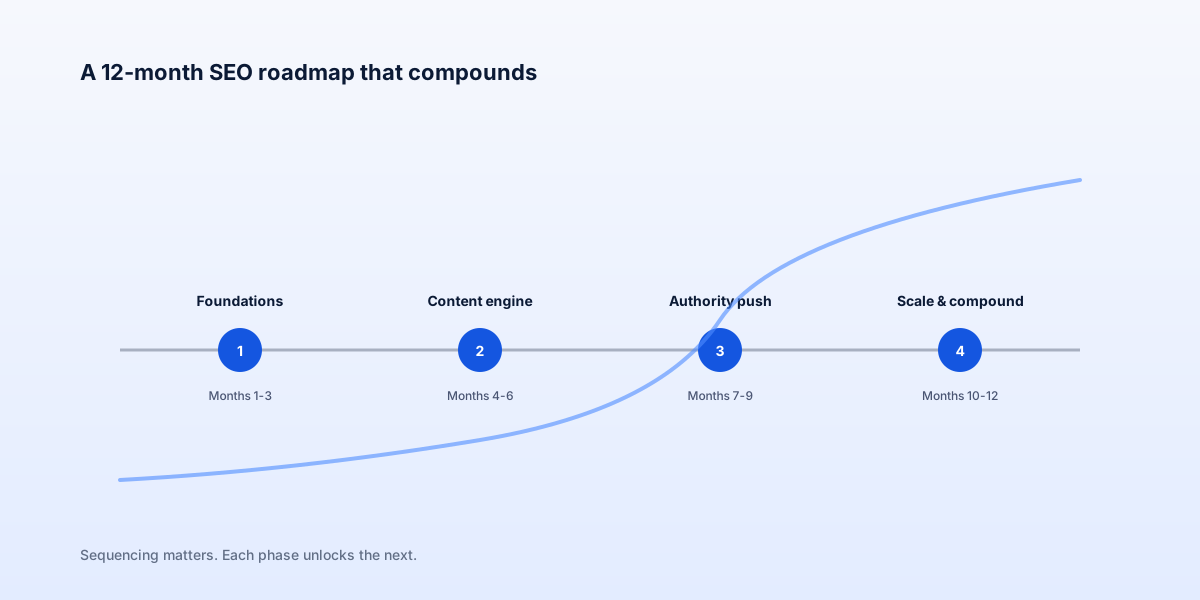
A roadmap that actually compounds has fewer moving parts than the typical agency deck suggests. It has four phases, in order, each with a clear definition of done. Each phase is sized to ninety days, with an explicit checkpoint at the end to course-correct before the next phase starts. This is roughly how we structure every custom SEO strategy engagement that runs longer than a quarter.
Why sequencing is everything
The reason sequencing matters more than tactical excellence is that SEO work has dependencies that are rarely visible until you violate them. Pushing for editorial backlinks to a product page whose content is thin and unoptimised wastes the link equity — the page will not convert the equity into rankings because it does not deserve the rankings on the underlying merits. Producing a high volume of content on a site with poor Core Web Vitals and broken internal linking burns content production budget without producing the rank lift that would justify it.
The compounding only kicks in when each phase has done its job before the next phase begins. Skip a phase, and the work you ship in later phases produces a fraction of the return it should.
Quarter 1 — Foundations (months 1–3)
The first ninety days are not glamorous and they do not produce rankings in any direct way. They make the rest of the year work. The deliverables:
Technical audit and remediation. Full crawl, identify and fix indexation issues, resolve duplicate content, clean up the redirect chain landscape, fix broken internal links, validate XML sitemaps, and address Core Web Vitals issues on the templates that serve the most traffic. The bar is not “perfect” — it is “no obvious technical debt actively suppressing the work you are about to ship.”
Site architecture and internal linking. Map the current information architecture, identify orphan pages, plan the hub-and-spoke structures that will eventually carry topical authority, and implement a navigational backbone that supports that structure. Internal linking work here is high-leverage because the same effort that takes a week on a small site can take three months on a large one — get it done while the surface area is still manageable.
Schema rollout. Implement the structured data that should have been there from the start: Organization, BreadcrumbList, Article on the blog, Product on commerce pages, FAQPage where appropriate. Validate everything in the Rich Results Test. This is leverage for the content work that comes next.
Keyword and competitor research. Build a working keyword universe, segmented by intent. Identify the head terms that drive category traffic, the long-tail clusters that support them, and the competitor pages currently winning each cluster. Output is a prioritised content roadmap for Q2, not a 500-keyword spreadsheet nobody will reference again.
Tracking. Search Console properly configured, GA4 events for the conversions that matter, rank tracking set up for the keyword universe, and a monthly reporting template that the executive sponsor will actually read. If you cannot measure progress, you cannot demonstrate value at the Q1 checkpoint, and the project loses budget at month three.
Definition of done for Q1: technical issues are no longer the bottleneck, the IA supports topical work, schema is live and validated, the content roadmap for Q2 is committed.
Quarter 2 — Content engine (months 4–6)
With the foundation in place, the second quarter is about getting a real content cadence shipping. The mistake here is treating “produce content” as a single deliverable. Two distinct streams need to be running in parallel.
Pillar production. The hub pages for each major category. These are slow, expensive, and load-bearing — typically 2,500 to 4,000 words, with bespoke imagery, proper schema, internal linking to cluster pieces (planned even if not yet written), and a clear commercial intent. Ship one pillar per month minimum during Q2; you should exit the quarter with three pillars live.
Cluster expansion. Supporting articles that target the question-shaped queries around each pillar. Higher volume, faster turnaround, tighter editorial process. Aim for eight to twelve cluster pieces per pillar over the engagement, with the first wave shipping in Q2 alongside the pillars they support.
Existing page optimisation. The pages already on the site that have rank potential — typically pages on page two for queries with real volume. These are quick wins: refresh content, improve internal links, fix schema, address the specific gap that is keeping them off page one. A skilled SEO can identify and execute on twenty to forty of these in a quarter, often with no new content production required.
Editorial calendar discipline. Weekly publishing minimum, ideally bi-weekly for pillar content. The single most common reason content engines fail is that the cadence slips when something more urgent comes up. Build the calendar to accommodate slippage; do not skip publication dates.
Definition of done for Q2: a working content cadence, three pillars live, the first wave of cluster pieces shipping, existing-page optimisation underway, the content team operating as a real production system rather than an ad hoc effort.
Quarter 3 — Authority push (months 7–9)
Once there is genuinely good content on the site, link building becomes worth doing. The order here is critical: links pointing to thin or poorly-optimised pages convert to rank lift much less efficiently than links pointing to pages that are already strong on merit.
Editorial outreach campaign. This is the main backlink work. Identify the pages most worth pushing — typically the pillars and the two or three highest-commercial-value supporting pages — and run a sustained outreach effort to earn placements pointing at them. Target ten to twenty placements per month from real publications in your category. Read our detailed thinking on link building for the mechanics.
Anchor diversification. Plan the anchor mix before the outreach starts. Branded, partial-match, exact-match, naked URL, and topical anchors at deliberate ratios. Over-optimisation on any single anchor type is the most common cause of campaigns that look promising but underperform.
Digital PR. Where it fits the brand, develop one or two data-led campaigns that earn editorial coverage at scale. Original data, surprising findings, news-pegged angles. The PR work pays off in branded mentions and entity reinforcement as much as in direct backlinks.
Internal link refresh. As new content has shipped through Q2, the internal link graph needs revisiting. Add links from older content to newer pages where the relationship is genuine, and from newer pages back to the pillars they support.
Definition of done for Q3: a sustained editorial backlink campaign in market, a defensible anchor profile across the priority pages, internal linking up to date with the content estate as it now stands.
Quarter 4 — Scale and compound (months 10–12)
The final quarter is where the prior work starts to compound visibly, and where the strategy either holds together or reveals the gaps. The work in Q4 is less about new initiatives and more about systematising what already worked.
Refresh program. Establish a monthly cadence of refreshing top-decile pages — updating data, improving internal links, addressing freshness signals, expanding sections where the SERP has shifted. The pages that already rank well give back the most for the least effort when refreshed regularly.
Programmatic SEO if relevant. If your category has a template-suitable opportunity — comparison pages, alternatives pages, location pages, product attribute pages — Q4 is when you ship the first wave. Programmatic work shipped in Q1 would have outpaced the underlying authority; Q4 is when the authority can absorb it.
SERP feature targeting. With pages now ranking, identify the SERP features they are close to — featured snippets, People Also Ask, image packs — and add the explicit content structures that capture them. This is detail work that yields outsized returns on pages already in the top ten.
Reporting and prioritisation for year two. The Q4 close-out report should be the basis for the next year’s plan. What worked, what did not, what compounded faster than expected, what compounded slower. The mistake at this point is to treat the twelve-month plan as the end of the project; if the work has compounded, the next twelve months should produce more, not less.
The checkpoint discipline
At the end of each quarter, run a structured checkpoint with the executive sponsor: what shipped versus what was planned, what the rank/traffic/conversion data is showing, what assumptions need updating, what (if anything) needs to change in the next quarter’s plan. Without this discipline, the roadmap drifts into “the agency is still working on stuff” and loses the ability to course-correct before problems compound.
The single biggest predictor of whether a twelve-month roadmap actually delivers compounding results is whether the team executing it holds the sequencing discipline through periods when the pressure to skip steps is highest — usually around month three when foundations work is wrapping up but rankings haven’t moved yet, and around month nine when the editorial outreach is in market but the rank lift is still building.
What to do next
If you are building a twelve-month plan now, the highest-value preparatory exercise is to write down the prerequisites for each phase explicitly. What technical issues would block content shipping in Q2? What content gaps would mean Q3 backlinks land on weak pages? What measurement do you need in place at Q1 to evaluate Q2? Surfacing these before the plan starts saves months of mid-plan re-engineering.
If you would like a second pair of eyes on your roadmap — or a roadmap built from scratch — that is exactly what our custom SEO strategy engagement produces. The output is a phased plan with deliverables, dependencies, and checkpoints, sized to the realistic capacity of your team and the realistic budget you have to spend.