
31 March 2026 · Linkiva Team Strategy
Fully Managed SEO vs DIY: A Framework for Choosing
When does it make sense to build SEO in-house versus engage a fully managed agency? A practical decision framework based on capacity, expertise, and the real cost model.
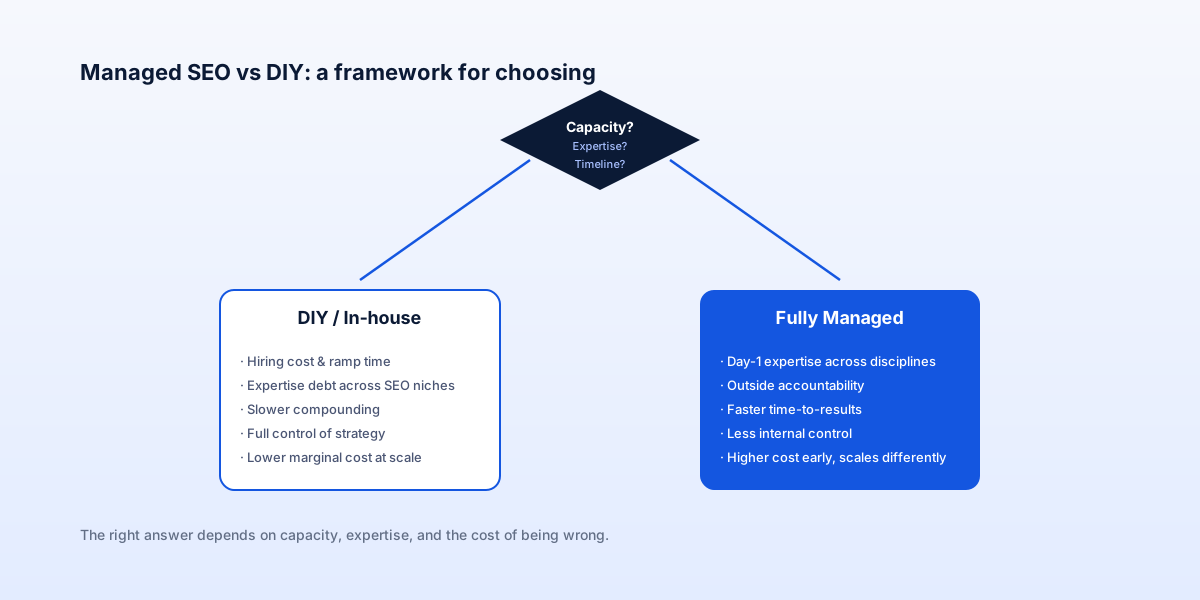
The managed-versus-DIY question for SEO is rarely answered well because most of the people answering it are selling one of the two options. Agencies argue you should hire them. In-house leaders argue you should build a team. Both arguments are correct for some companies and dangerously wrong for others, and the right answer for any specific business depends on a handful of dimensions that almost nobody walks through honestly.
This piece is the framework we use when prospective clients ask us whether they should engage fully managed SEO or build internal capacity. We sell the managed service, so this is not unbiased — but it is honest. There are situations where the right answer for a prospective client is “build it in-house” and we say so when it applies. The framework below produces both answers depending on the inputs.
What “fully managed” actually means
The most common confusion in this conversation is what “fully managed SEO” delivers. The serious version is a multi-discipline team — strategy, technical SEO, content production, link building, analytics — operating as an extension of the client’s marketing function, with weekly delivery cadence, monthly reporting, and quarterly strategic reviews. It is not “a person who edits your title tags.”
The cost reflects the staffing. A serious managed engagement runs from a few thousand pounds per month at the floor to mid five figures monthly for ambitious programs across competitive verticals. Anything materially below that floor is either a single-discipline service (just content, just links, just technical) being labelled as managed, or a thin team stretched across more clients than the work allows.
DIY at equivalent scope is the in-house version of the same team: a head of SEO, a technical SEO specialist, a content lead with writer support, a link-building or PR specialist, and partial analytics support. The all-in cost at full employment loading is substantial — typically £250k–£500k+ annually depending on geography and seniority — before counting tooling, recruitment, and the productivity cost of building a team from scratch.
The two options are not equivalent in cost at small scale. A managed engagement that delivers the equivalent output of a five-person in-house team will cost less than that team, because the agency is amortising the team across multiple clients. The crossover where in-house starts to be more cost-effective is generally when the volume of work exceeds what a single managed engagement can deliver — at which point a hybrid model usually beats either pure option.
Dimension 1: existing in-house capacity
The first question to ask is what capacity you already have. A marketing function with one generalist marketer covering everything is a different starting point than a function with an existing SEO specialist, a content team, and a technical lead.
If you have zero SEO expertise on the team: managed is almost always the right starting point. Building a competent team from a standing start takes 9–18 months — recruitment, ramp, internal-relationships, learning the existing site and its history. During that period, the SEO work either happens at low quality or doesn’t happen at all. A managed engagement compresses that timeline because the team is already built.
If you have one strong SEO generalist: hybrid. The in-house person owns strategy and stakeholder management. A managed engagement supplements with the specialist disciplines they cannot cover alone (technical SEO at depth, content production at volume, link building as a sustained program).
If you have a full in-house SEO team: managed services may still make sense for specific gaps — link building is the most common, because in-house link teams are hard to staff and hard to keep busy enough to justify dedicated headcount. Full managed of the entire SEO function rarely makes sense at this scale; you have already paid the fixed cost of building the team.
Dimension 2: timeline pressure
SEO compounds, which means the cost of being late is paid twelve months later, not immediately. The teams that can afford the eighteen-month ramp of building in-house are the teams without a strong commercial timeline pressure.
If the business has a twelve-month organic-growth target tied to fundraising, an exit timeline, or a critical commercial deadline: managed wins by default. The eighteen-month ramp of building in-house arrives after the deadline. The right answer is to engage a managed team for the urgent twelve months and decide about in-house build during that time when there is less pressure.
If the timeline is two or three years and the company is otherwise stable: in-house build becomes a real option, possibly the better long-term option. Managed services for the first six to twelve months while the in-house team ramps, with a planned transition once internal capacity is sufficient.
If there is no specific commercial timeline: this is the case where pure DIY is most likely to be the right answer for a financially patient business, because the long-term cost economics favor in-house at sustained scale.
Dimension 3: expertise depth required
SEO subdisciplines have very different depth requirements. A generalist can credibly cover most areas at a basic level. Specific deeper areas — technical SEO at scale, programmatic SEO, GEO, link building at sustained volume, enterprise schema work — require specialised expertise that takes years to build.
If your SEO challenges are mostly in the generalist surface area (content, basic on-page optimisation, basic technical hygiene): an in-house generalist can handle most of it, and a managed engagement is largely substitutable for in-house capacity.
If you have specific deep challenges (a 50,000-page ecommerce site with crawl budget issues, a programmatic SEO buildout, a competitive vertical where link building is the deciding factor): the depth of expertise required is hard to hire for and even harder to retain. A managed engagement that already has people with the specific deep expertise is qualitatively different from any plausible in-house build.
The teams that think they can build the deep expertise in-house often underestimate how rare the senior specialists are and how much they cost. The market rate for a senior technical SEO with enterprise experience is meaningfully higher than the budget most in-house functions allocate for the role.
Dimension 4: the cost of being wrong
This is the dimension most overlooked. SEO work that is done badly is worse than no SEO work — penalties, devalued domain authority, wasted content production budget, opportunity cost. The downside risk of a bad in-house hire who runs the wrong link strategy for eighteen months before the problem is identified can be substantial.
Managed services carry the same downside risk in principle, but the risk profile is different. A managed engagement is contracted, scoped, and can be discontinued. An in-house hire is harder to remove, takes longer to evaluate, and has more institutional inertia. For a business in a regulated vertical, in a competitive vertical, or with a brand where a penalty event would be commercially serious, this asymmetry favors managed during the early stages.
The hybrid that usually wins
For most companies in the middle of these dimensions, the answer is neither pure managed nor pure DIY. It is hybrid. A common pattern that works well:
- One senior in-house SEO leader, owning strategy, stakeholder relationships, and accountability.
- A managed engagement covering the multi-discipline execution: technical depth, content production capacity, link building program, analytics support.
- Regular handover of well-documented playbooks from the managed team to the in-house function as appropriate, with the option to transition specific disciplines in-house when the volume and stability justifies it.
This structure scales well: the managed engagement absorbs the work that scales unpredictably or requires specialist depth, while the in-house leader provides continuity, business context, and decision-making authority. It also avoids the “two teams, no clarity” failure mode that happens when both managed and in-house both think they own strategy.
For early-stage companies, a custom SEO strategy engagement at the planning stage often clarifies which of these models is right before committing to either. The output is a sized plan against the actual budget and capacity available, which makes the build-vs-buy conversation concrete.
A simple decision matrix
If forced into a simple matrix, the decision usually falls out like this:
| Situation | Default recommendation |
|---|---|
| New brand, no internal SEO, twelve-month commercial pressure | Managed |
| Established brand, generalist marketer, ambitious growth goals | Managed or hybrid |
| Established brand, in-house SEO lead, multi-discipline execution gap | Hybrid |
| Mature brand, full in-house team, specific gap (usually links) | Managed for the gap only |
| Stable business, no timeline pressure, patient capital, willing to build | In-house |
| Tiny business, very small budget | Selective DIY on highest-leverage tasks only |
The matrix simplifies away the real complexity but captures the dominant patterns. Real decisions involve weighing the dimensions against each other and against the specific constraints of the business.
What we’d recommend you do
If you are inside this decision, the most useful next step is not to choose between managed and DIY abstractly. It is to scope the actual work the business needs done over the next twelve months — specific deliverables, specific outcomes, specific dependencies — and then evaluate which delivery model can actually produce that work given your existing capacity and budget. The choice usually becomes obvious once the work is concrete.
If you would like that scoping done formally, both our fully managed SEO and our custom SEO strategy services include the diagnostic. We are not selling everyone the same answer; we will tell you when in-house is the right call and where the managed engagement adds the most value.