
4 May 2026 · Linkiva Team Link Building
Link Insertions vs Guest Posts: When to Use Each
Link insertions and guest posts solve the same problem differently. Here's how the mechanics, economics, and ideal use cases compare — and when each is the right call.
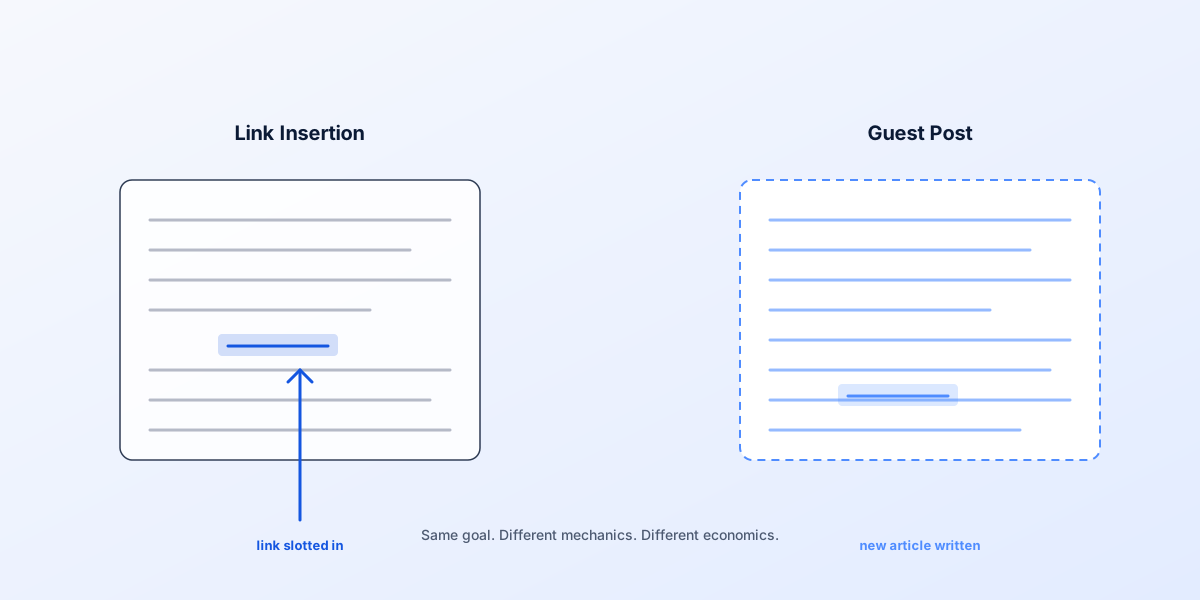
Link insertions and guest posts are the two dominant editorial backlink tactics for any serious link-building program. Most agencies sell one or the other and frame the rest of the world as either misguided or outdated. The reality is that they are different tools for different problems, and a mature backlink program uses both deliberately — guest posts where you need a fresh piece of branded content with a controlled message, link insertions where you need rank-relevant equity transferred to a specific page fast.
This piece walks through how they actually compare on the dimensions that matter: indexation speed, equity transfer mechanics, cost, scalability, and the use cases each is genuinely better at. Both are services we run — link insertions and outreach-driven guest posts — and we pick between them on a per-page, per-campaign basis.
What each one actually is
A guest post is a new piece of editorial content that you (or someone writing on your behalf) places on a third-party publication, including a link or two back to your site within the body of the article. The publication agrees to publish in exchange for content, and you agree to write content that meets their editorial standard. The page is new — it did not exist before your placement.
A link insertion is the addition of a link to your site within an existing piece of content on a third-party publication. The article was written and published before you came along; you are negotiating with the publisher to add a link within the existing text, usually at a contextually relevant point.
The mechanics matter because they have downstream consequences for everything else.
Indexation speed
This is the dimension where link insertions consistently win. The host article already exists, has been crawled, has accumulated internal links from elsewhere on the publication’s site, and may have been indexed for months or years. When the link is inserted, Google often picks it up on the next crawl of that page — which, for an active publication, is typically days, sometimes hours.
A guest post is a brand-new URL. The publication’s CMS produces it, internal links propagate to it over the next few crawls, and Google’s index has to discover it via the homepage, the category page, the XML sitemap, or — most reliably — the internal links from other recently-crawled pages on the publication. Indexation typically takes one to four weeks for a guest post on an established publication, longer on a smaller site.
For campaigns where time-to-effect matters — a product launch, a category push, a competitive response — link insertions consistently deliver faster.
Equity transfer mechanics
Both formats pass link equity through the same underlying mechanism: PageRank flow, modified by the host page’s authority, the link’s position, the surrounding content, and the anchor text. The differences are subtler than most agencies suggest.
A guest post’s host page starts with zero links pointing at it. Whatever equity it ever transfers to your site comes from the equity that the publication’s internal links and external mentions pass to it over time. The strongest guest posts accumulate equity for years as the publication’s own authority grows and as more internal links point at the post. The weakest ones sit in the publication’s archive forgotten and pass little of anything.
A link insertion lands on a page that already has equity — sometimes substantial equity, if the host page has been built up and linked to over time. The link is benefiting from years of accumulated authority on day one. If the host page is genuinely strong (real organic traffic, real backlinks, real engagement), a link insertion can be one of the most valuable single placements you can buy.
The caveat: an insertion on a page that the publication built only to sell insertions, with no organic traffic and no real backlinks, is worth less than a guest post on a real piece of content. The quality of the host page is the determining factor, not the format.
Contextual relevance
Guest posts give you near-total control of context. You write the article, you decide the topic, you ensure the surrounding content is topically aligned with your link. The downside is that aggressively-aligned guest posts read as link-bait and signal “this exists to host a link” to anyone — including, increasingly, Google’s content quality models.
Link insertions trade some control for authenticity. The host article was not written to host your link. The context is whatever the original author chose to write about — which may be a perfect fit or may be a stretch, depending on the page. Skilled outreach involves finding pages where the natural context already supports the link, not forcing a link into content where it does not belong.
For commercial pages targeting head terms in your category, the ideal is link insertions on pages whose existing content is already discussing your category. For thought-leadership pages or new launches, guest posts give you the editorial latitude to set up the link properly.
Cost and scalability
Per-link, link insertions and guest posts on comparable publications are typically priced in the same range. The cost composition differs, though: guest post pricing includes the writing labour; insertion pricing is essentially placement fee only. For clients producing their own content, the all-in cost of a guest post can be higher than an insertion of equivalent host-page quality.
Scalability favours insertions modestly. The bottleneck for guest posts is usually content production capacity and the publication’s editorial review pipeline; both throttle the number of placements achievable per month. Insertions involve no content production and shorter editorial review (a publisher reviewing an insertion request needs to validate the link, not edit a 1,500-word article), so a competent outreach team can run more insertion placements than guest posts at the same staffing level.
The trade-off is that insertion opportunities are constrained by the inventory of host pages that meet the quality bar AND that the publication is willing to modify. Guest posts can be pitched to any publication that accepts contributions; insertions require an existing article worth inserting into.
The other scalability factor that matters at sustained volume is publisher relationships. The first time you place a guest post with a publication, you are pitching cold and the editorial process is slow. By the third or fourth placement with the same publication, the editorial team knows your work, the turnaround compresses, and the pitching cost drops. Insertions do not benefit from this relationship-building in the same way — each insertion is a separate transaction about a specific page, with less ongoing relationship value. Programs that aim to scale need to factor in which format produces durable publisher relationships and which produces one-off transactions.
Ideal use cases for each
Link insertions are usually the better tool when:
- The page you are pushing already has supporting content and you need rank-relevant equity transferred fast.
- You have identified specific high-authority host pages where the existing content naturally supports a link to yours.
- The anchor you want is best deployed in a context that already exists in the wild.
- You want supporting placements at scale around an editorial flagship.
- Your in-house team produces strong commercial pages and just needs the links pointed at them.
Guest posts are usually the better tool when:
- You need a new piece of branded content on a publication for reasons beyond the link itself (entity reinforcement, audience reach, sales-team artefact).
- The publication does not accept insertions but does accept contributions.
- You want full editorial control over how your brand and product are presented in the placement.
- You are building thought leadership presence on a publication and a single guest post will plausibly be one of a series.
- The page you are pushing is a new launch or a thin commercial page that needs editorial framing to make the link land naturally.
What we’d actually run for a typical client
A balanced editorial backlink program at Linkiva usually runs both. The default ratio we propose for an established brand is roughly two-thirds insertions to one-third guest posts during steady-state, shifting toward more guest posts during launches or rebrands where the editorial framing is part of the work.
The most common mistake we see in client backlink profiles is exclusively guest posts (typically when the previous agency was a guest-post specialist) — which produces a profile heavy on contributed content and light on the kind of high-authority insertions that often move rank fastest. The second most common is exclusively insertions (typically when the previous agency was a “niche edit” specialist) — which produces a profile with no branded editorial coverage and no entity reinforcement on real publications.
The right answer is almost always a mix, sized to the specific campaign and the specific pages being pushed.
What to do next
If you are evaluating link-building options and trying to figure out which format makes sense for your situation, send us your domain, your priority pages, and the rough budget you have to work with. We will come back with a per-page recommendation: insertions, guest posts, mixed, or “neither, do this other thing first.” Both link insertions and editorial outreach are services we run, and the right answer for you depends on the specifics rather than the format.