
7 April 2026 · Linkiva Team Geo
How AI Search Engines (ChatGPT, Perplexity, Gemini) Choose What to Cite
A practical look at the retrieval and citation mechanics inside ChatGPT, Perplexity, and Gemini — what signals drive citation choice, and how to build content that gets quoted.
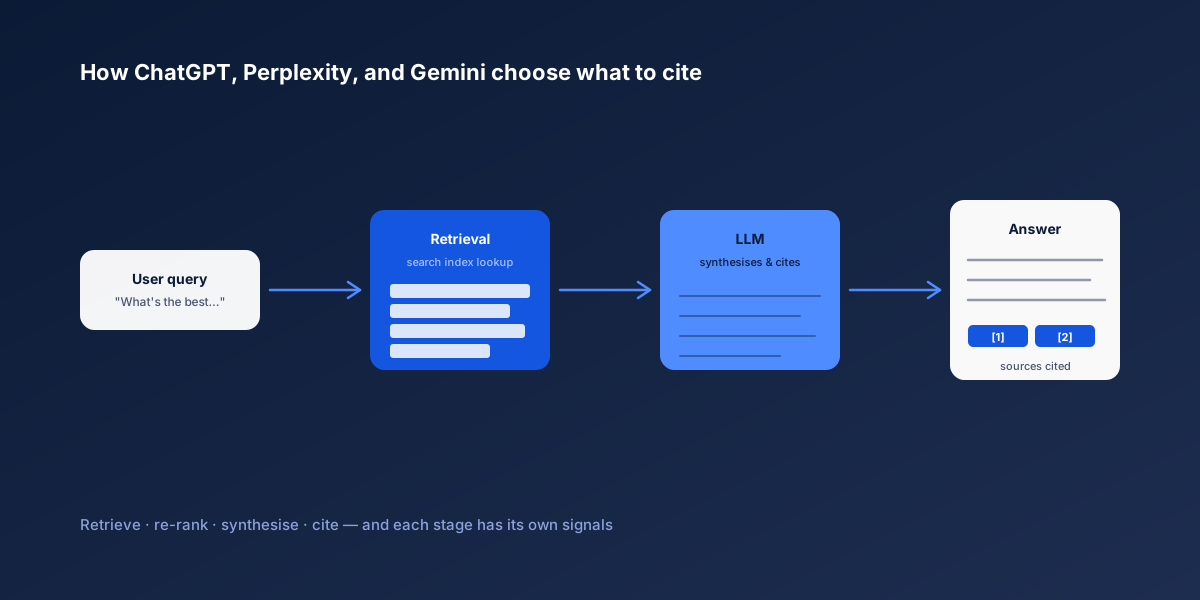
If you want your content to show up inside AI-generated answers, you need a working model of how those answers actually get produced. The marketing-deck version — “the AI picks the best source” — is so wrong it actively misleads people about where to put their effort. The reality is a multi-stage pipeline with distinct steps, distinct signals, and distinct levers you can pull at each step.
This walks through the actual mechanics inside the four answer engines that matter most in 2026 — ChatGPT, Perplexity, Gemini, and Google’s AI Overviews — and what each stage means for the content you publish. It is the operating model we use for every GEO engagement at Linkiva.
Stage 1: query understanding and reformulation
When a user types a question, the engine first has to convert that question into something a search index can answer. This involves identifying the entities involved, the intent (informational, comparison, recommendation, transactional), and any constraints (location, time, audience). The engine then often reformulates the question into one or more underlying queries — sometimes a single query, sometimes a fan-out of three to eight sub-queries that together cover the answer space.
The implication for content: the entities in your content matter more than the exact phrasing. A page titled “How to choose a CRM for a 50-person SaaS company” will rank for the reformulated underlying queries even though no user types exactly that phrase. The page wins because it covers the entities the reformulator extracts from the user’s question.
The leverage: think in entities and questions, not in keywords. Audit your top pages for whether they cover the entities a reformulator would extract from the queries you want to win, and whether they answer the questions the reformulator would ask of those entities.
Stage 2: retrieval
The retrieval step is where classical SEO meets GEO. The engine sends the reformulated queries to a search index — Bing for ChatGPT and Copilot, Google for Gemini and AI Overviews, a custom index for Perplexity that blends multiple sources. The index returns ranked candidate documents, and the engine selects from those candidates.
This stage is the reason “GEO replaces SEO” claims are wrong. If your page does not rank in the underlying retrieval index, it is not a candidate to be cited. Classical ranking signals — page authority, backlink profile, content quality, freshness, technical SEO — all still matter because they all influence which pages make it into the candidate set.
The leverage: a page that consistently ranks in the top 10 to 20 results for the queries the reformulator would generate is a much stronger GEO candidate than a page that ranks on page 5. The bar to be cite-eligible is roughly “regularly in the top 20 candidate set” rather than “number 1 organic” — which is a lower bar than ranking for traditional SEO, but a non-zero one.
Stage 3: passage extraction and re-ranking
The retrieval step returns pages. The engine then has to extract the relevant passages from each page and re-rank them against the original question. This is where most of the GEO-specific signals live.
A page with a clear definitional sentence at the top, followed by structured supporting content (lists, tables, FAQs), is dramatically easier for the extraction layer to parse than a long flowing essay that buries the answer in the middle. The extracted passages are the unit the engine evaluates, and the engine prefers passages it can quote with high confidence.
The signals at this stage:
- Passage extractability: short, declarative sentences that contain a complete answer. Definitional openings, FAQ-style Q&A pairs, comparison tables.
- Schema and structured data: tells the extractor what kind of content this is and how to parse it. FAQPage, HowTo, Article schema all do real work here.
- Heading hierarchy: H2/H3 headings that mirror the user’s question give the extractor a fast path to the relevant section.
- Surrounding context: a quotable passage in a page whose surrounding paragraphs are topically aligned scores higher than the same passage in a page where the rest is off-topic.
This is the layer where most teams have the most to fix. A page that ranks well in retrieval but loses to a competitor at re-ranking has a content-format problem, not a ranking problem.
Stage 4: source selection and citation
Once candidate passages are re-ranked, the engine selects which passages to cite. Citation selection is not just “the highest-ranked passages” — it is a balance of relevance, authority, diversity, and freshness.
Relevance: the passage directly answers the user’s question, not adjacent to it.
Authority: the source domain is recognised as authoritative for this entity or topic. Entity-graph presence (Knowledge Graph, Wikidata) feeds this. Established brands in the category are favoured over unknown domains.
Diversity: most engines explicitly avoid citing two sources that say the same thing in the same way. If your competitor is already cited with the same point, your similar passage may not be added; a passage that offers a complementary or contrasting angle gets the spot.
Freshness: for queries with temporal sensitivity (anything involving “current”, “2026”, a recent event), recent content is preferred. Stale content loses citations even when the underlying point hasn’t changed.
The leverage at this stage:
- Build entity-graph presence. Get on Wikidata if eligible. Maintain a Knowledge Panel. Ensure your sameAs links across major platforms are consistent. This is a slow, compounding investment.
- Differentiate your angle. If your content says the same thing as five competitors, expect to lose the citation to one of them. Find the angle that complements rather than duplicates.
- Maintain freshness. Pages on time-sensitive topics need a refresh cadence. The dateModified in your schema, the visible publication date, and the actual recency of the content all factor in.
Engine-specific differences
While the four-stage model is roughly universal, the engines differ in important ways:
ChatGPT with web browsing uses Bing as its retrieval index and tends to cite a small number of sources per answer (typically two to four). Citation positioning is inline. ChatGPT is more willing to synthesise across sources without quoting any single one verbatim, which can mean your content informed the answer without an attributed citation.
Perplexity uses its own retrieval blend, cites more sources per answer (typically four to eight), and shows sources prominently in a sidebar. Perplexity is the easiest engine to test GEO performance on because attribution is so visible. It also tends to prefer recent content more aggressively than the others.
Gemini uses Google’s search index directly. Citation patterns favor pages that also rank well organically, with stronger weighting on Google’s traditional E-E-A-T signals. AI Overviews behavior is similar to Gemini in mechanics. Pages that already rank well in Google organic search are heavily over-represented in Gemini citations.
Google AI Overviews are produced inline on the Google SERP and source from pages indexed in Google. AI Overview citations tend to favor pages with clear FAQ blocks, definitional content near the top, and strong schema. They also rely heavily on the page’s organic ranking position — if you are not in the top 20 organic results, you are very unlikely to appear in the AI Overview.
The practical conclusion: optimising for Bing retrieval (for ChatGPT), Google retrieval (for Gemini and AI Overviews), and Perplexity’s own index simultaneously is mostly the same work. Classical SEO best practices for Google retrieval also serve you well for ChatGPT via Bing, because Bing’s ranking signals overlap heavily with Google’s.
Building a prompt set for measurement
Because none of the engines provide a “search console” equivalent, GEO measurement is something you build yourself. The minimum-viable approach: a hand-curated prompt set of 30–100 queries your buyers would actually ask, run monthly against each engine, recording presence, citation position, and competitor citations.
A good prompt set:
- Mixes intent types: definitional (“what is X”), comparison (“X vs Y”), recommendation (“best X for Y”), and how-to (“how do I X”).
- Includes branded queries to track citation rate when buyers search you directly.
- Includes competitor-branded queries to track when AI engines cite you in answers about competitors.
- Includes long-tail intent queries specific to your category.
Run the prompt set monthly. Track changes over time. Use the results to prioritise content improvements: pages where you are close to being cited but losing on one specific dimension are the highest-leverage targets.
What changes for your content roadmap
If you are taking GEO seriously, three things in your content roadmap need to update:
- Passage formatting becomes a primary concern. Every page that should be cite-eligible needs at least one quotable definitional passage at the top, plus appropriate structured formats (FAQ, comparison table, numbered steps) for the intent.
- Schema implementation moves up the priority list. FAQPage, HowTo, Article with proper author and dates, Organization with full sameAs — these are doing more work than they used to.
- Refresh cadence matters more. Stale content loses citations. Plan a monthly refresh cycle on your highest-value pages, with the dateModified updated when you make substantive edits.
These all overlap with good classical SEO practice, but the emphasis shifts. The pages that win GEO citations are not necessarily the pages that rank #1 organically — they are the pages that are simultaneously ranked, formatted for extraction, and credible at the entity level.
What to do next
If you have not run a citation audit before, the right starting move is to build the prompt set and run it once. The output is a baseline measurement and a prioritised list of where you are absent on queries you should own. From there, the work prioritises itself.
If you would like us to run the prompt-set audit and turn it into an actionable plan, that is what our GEO service delivers. We will build the prompt set with you, run the baseline across all four major engines, and produce a 90-day work plan focused on the highest-commercial-value gaps.