
14 April 2026 · Linkiva Team Link Building
SEO Foundation Links: Why New Sites Need a Citation Baseline
Foundation links are the load-bearing layer beneath every serious link campaign. Here's why they matter, what counts as a foundation link, and the order to build them.
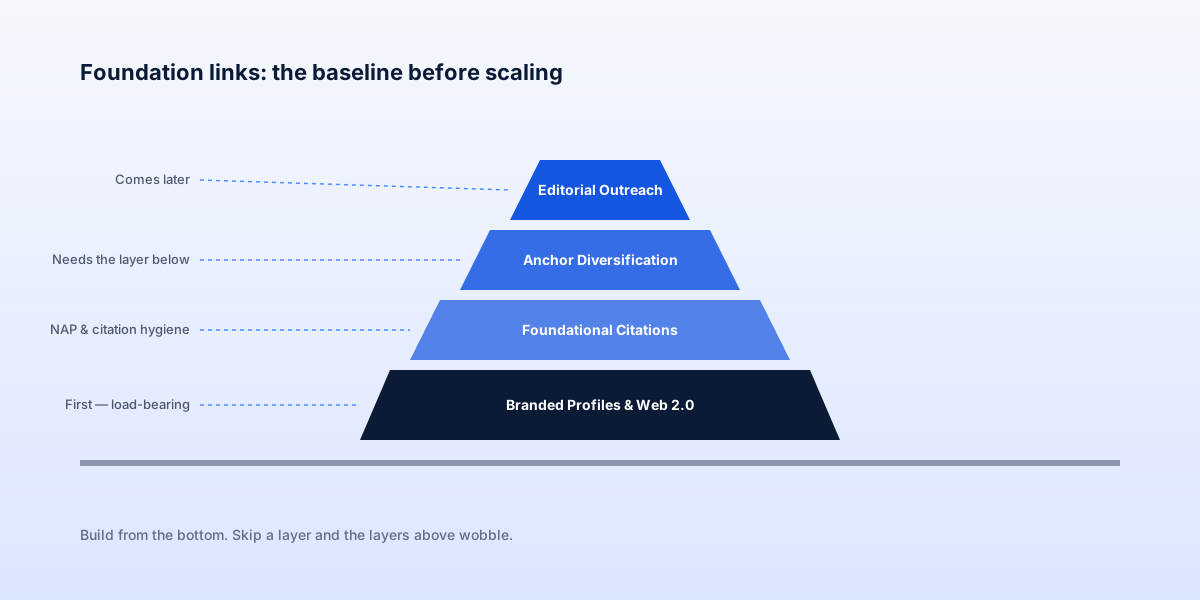
Foundation link building is one of the most under-rated disciplines in SEO and one of the most consistently skipped steps in modern link campaigns. The pattern we see repeatedly with new clients: a backlink profile that goes straight from “almost no links” to “a handful of editorial placements”, with none of the foundational citation and branded-profile work that should sit beneath them. The campaigns that build on that thin foundation underperform; the campaigns that put the foundation in first compound faster and last longer.
This piece covers what foundation links actually are, why they matter, the order to build them in, and where they fit alongside editorial outreach. Foundation work is a deliberate part of every foundation link building engagement we run, particularly for sites under two years old.
What “foundation” actually means in link building
Foundation links are the baseline layer of citations, branded profiles, and topical references that establish your brand as a real entity in the eyes of search engines and AI systems. They are not the editorial backlinks that drive rankings on competitive head terms; they are the substrate beneath which the editorial work either works or doesn’t.
The category includes:
- Structured business citations: listings on the major data aggregators (Data Axle, Foursquare, Localeze in the US; Yell, Thomson, the equivalents elsewhere) and the vertical directories specific to your industry.
- Branded profile pages: Crunchbase, LinkedIn company page, Glassdoor, Trustpilot, G2 or Capterra if relevant, the major industry-specific platforms.
- Web 2.0 properties: properly-built branded presences on the major user-generated platforms that have authority in search — Medium, GitHub for technical brands, About.me, the relevant industry platforms.
- Social profile claims: not for the backlinks themselves (most are nofollow), but for entity reinforcement and brand SERP coverage.
- Topical reference sites: industry-specific directories and reference platforms where genuine business listings live, not link farms dressed up as directories.
Each of these individually does relatively little. Collectively, they form the entity-recognition foundation that the rest of the link-building program depends on.
Why new sites need this before editorial work
A new site running editorial outreach without a foundation layer looks suspicious to Google’s link analysis in a specific way. The pattern — a brand-new domain suddenly receiving editorial links from real publications, with no underlying citation footprint, no branded profile presence, no entity recognition signals — is one of the patterns associated with sites paying for editorial coverage that has not been earned through brand-building work.
The fix is not subtle: build the foundation first, then layer the editorial work on top. A site with a complete citation footprint, branded profiles on the platforms that matter for its category, and a real entity signature looks like a normal business that has been operating long enough to do the basic work, and the editorial coverage that arrives subsequently looks like the natural progression of a brand earning attention.
This is not about gaming Google’s perception; it is about not looking inadvertently suspicious. Real businesses build foundation footprints because they need to be found across the platforms their customers use. SEO link campaigns that skip this step are doing something real brands don’t do.
NAP and citation hygiene
The single largest mistake in foundation link work is treating citations as a one-off setup task and not as ongoing hygiene. Citations only do their job when the name, address, and phone number (NAP) data is consistent across every platform where the business appears. Inconsistent NAP — three variations of the business name, two phone numbers, an old address still listed somewhere — actively undermines the entity-recognition value of the citations.
The discipline:
- Pick canonical versions. One exact spelling of the business name. One address format with one set of postal abbreviations. One phone number with one format.
- Audit the existing citation landscape via a tool that pulls from the major aggregators and key vertical directories.
- Correct or suppress every inconsistency. Duplicate listings should be suppressed rather than ignored.
- Establish an ongoing review cadence — quarterly is fine for most businesses — to catch drift before it accumulates.
Without this hygiene, citation work is producing fewer than half the entity signals it should.
The order of building
If you are starting a foundation-link program from scratch, the order that consistently produces the cleanest result:
Phase 1 — branded profile claims. Claim the brand profile on every major platform first. Even if you are not going to actively use most of them, the claim itself prevents impersonation and ensures consistent entity assertion. Include: LinkedIn company page, Crunchbase, Glassdoor, Trustpilot, the major social platforms, and the vertical platforms relevant to your category.
Phase 2 — data aggregators. Submit to the major aggregators that feed downstream directories and map products. This is the single most efficient way to populate the citation landscape because each aggregator submission propagates to dozens of derivative directories over the following weeks.
Phase 3 — vertical directories. The directories specific to your industry. These vary by vertical and by region but are usually identifiable by looking at where competitor businesses in your category appear consistently.
Phase 4 — secondary citation sources. General business directories, chamber of commerce membership pages, partner-organization member lists, and the long tail of business listing sites that have meaningful authority in your geography or category.
Phase 5 — branded web 2.0 properties. Active presence on the platforms where it makes sense for your brand: a Medium publication for thought leadership, a GitHub org for technical brands, a YouTube channel with branded video content. These take ongoing effort, so be honest about which ones you will actually maintain.
This sequence takes roughly six to twelve weeks for a small business and three to six months for a larger or multi-location business. It compounds for years afterward.
Anchor diversification at the foundation layer
Foundation links contribute one specific value to a backlink profile that editorial links rarely do well: they provide the branded-anchor mass that makes the rest of the profile look natural. A real brand has hundreds of links pointing at it where the anchor text is just the brand name, the URL, or a generic phrase like “visit the site.” These come naturally from directory listings, profile pages, and social references.
Editorial campaigns that produce exact-match commercial anchors without this branded baseline create over-optimised profiles that are detectable. The foundation layer dilutes the anchor profile in exactly the way a natural backlink profile is diluted, which makes the editorial layer above it look healthier.
The implication: foundation work is anchor-diversification work that happens to also build entity signals and citation hygiene. The branded anchors it produces are not a side effect — they are part of the strategic point.
What foundation links are not
A few things foundation links are NOT, despite being sold as foundation by some vendors:
- Bulk directory submissions to 500+ low-quality directories: this is a noise generator, not a foundation. Most of those directories are link farms or aggregator pages that pass no useful signal.
- Profile-page link farms: sites that exist purely to host paid profile pages, with no real user adoption. Detectable and devalued.
- PBN-style branded sites: a network of branded properties controlled by an operator and used to pass links between each other. This is PBN work, not foundation work, and carries the same risk profile.
- Social bookmark spam: submitting your pages to old social bookmarking platforms. The platforms are largely defunct as social systems and the “links” are devalued.
A defensible foundation program builds genuinely useful presences on real platforms used by real businesses. If a “foundation link package” offers hundreds of links for a low fixed cost, it is producing noise — not foundation.
When to scale up to editorial
Once the foundation is in place, the editorial work compounds faster. The typical sequence for a new site: foundation work in months 1–3, technical and content foundations in parallel, editorial outreach starting in months 4–6 with the prerequisites met. Sites that try to compress this — running editorial outreach in month one alongside foundation work — usually see the editorial work underperform because the entity recognition is not yet established.
For established sites that have been doing serious editorial work without a clean foundation, the foundation pass is a quick win. It is cheap relative to editorial outreach, it compounds slowly but indefinitely, and it makes the editorial program look healthier in Google’s eyes. We routinely add a foundation cleanup to existing engagements when the audit shows the citation landscape is weak.
What to do next
If you are launching a new site or relaunching an existing one with serious SEO ambitions, foundation link work is the cheapest and least glamorous part of the program — and the part most often skipped. Doing it properly in the first three months saves several months of stalled progress later.
If you would like a foundation audit run against your current citation footprint, that is the front-end of our foundation link building engagement. The output is a report on what is present, what is missing, what is inconsistent, and a prioritised plan for getting the foundation to where it should be before any further editorial scaling.