
12 May 2026 · Linkiva Team Link Building
Editorial Link Building vs PBN: An Honest Comparison
Editorial outreach and PBNs solve different problems with very different risk profiles. Here is the honest case for and against each, and how to decide between them.
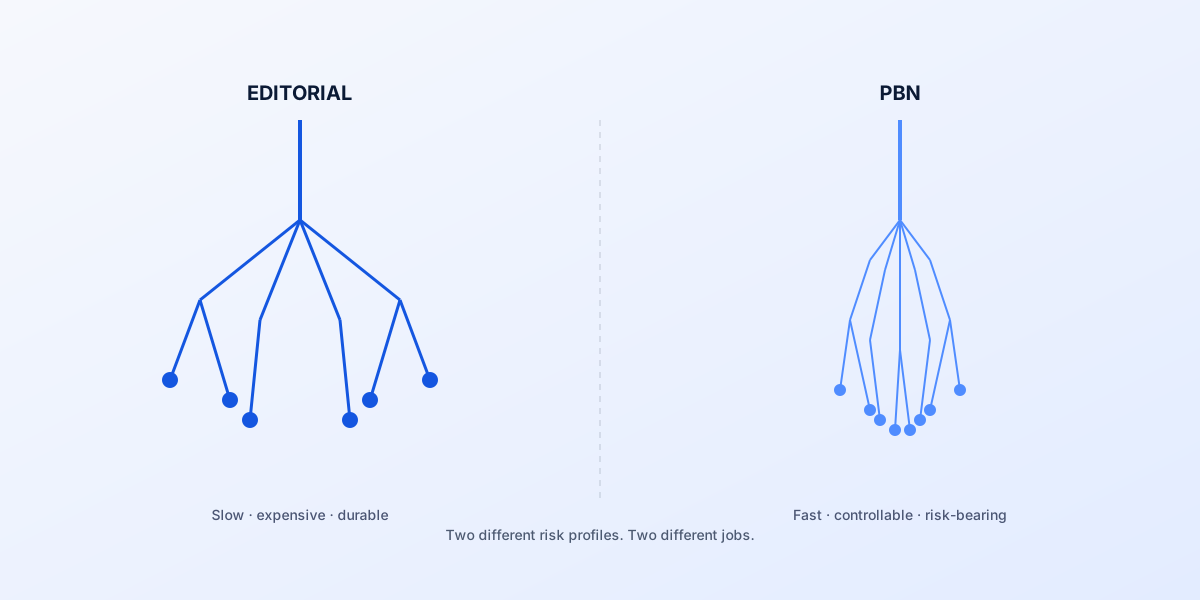
The editorial-versus-PBN argument is one of the few SEO debates where almost every public take is dishonest. Editorial-link agencies pretend PBNs are dead and dangerous; PBN agencies pretend editorial links are slow and overpriced. Both are partly right and mostly arguing past each other, because they are comparing tools that do different jobs.
This is a working comparison from a shop that runs both — our editorial outreach and PBN services are deliberate alternatives, not competing products. We pick between them based on the client’s risk tolerance, timeline, and target page profile. Here is how that decision actually gets made.
What “editorial” actually means
In the strict sense, an editorial link is a link placed in genuine third-party content, either via outreach (you pitch the placement) or earned (the publication finds the content itself worth linking to). The publication is real, the content is real, the audience is real, and the link sits inside content that exists for reasons other than the link.
The variations matter. A guest post on a real publication with editorial oversight is an editorial link. A guest post on a marketplace that exists primarily to sell links is technically “editorial” in form but functionally indistinguishable from a low-quality PBN. The signal is whether the publication has a real audience and editorial standards that exist independently of paid placements.
Real editorial links share a cluster of characteristics: the publication has organic traffic from sources other than the linked pages, the article would plausibly have been written without the link, the link is contextually relevant to the surrounding content, the publication has been online for years with consistent posting, and the editorial process involves at least one human who would reject a placement that did not fit.
What a PBN actually is
A Private Blog Network is a set of websites controlled by a single operator (or rented through a network) used to place links to client sites. The defining feature is control: the operator owns the publication decision, so the link can be placed, modified, or removed at will. There is no editorial gatekeeper; the operator IS the editorial gatekeeper, and they are working on your behalf.
PBNs sit on a spectrum. At the high end, a serious PBN is a portfolio of expired domains with real historical authority, rebuilt with genuinely useful content, hosted on diverse infrastructure, and operated with discipline. At the low end, a PBN is a collection of obviously thin sites on cheap shared hosting with auto-generated content, linking out to anyone who will pay.
The high end of the PBN spectrum produces links that are technically indistinguishable from editorial placements when looked at individually. The low end produces links that are detectable, devalued, or actively penalised.
The honest case for editorial
Editorial links are the only links that genuinely cannot be devalued by an algorithm change, because they are the kind of links the entire ranking model is designed to credit. A publication that has its own audience and editorial standards is exactly what Google’s link analysis was built to reward. As Google’s understanding of link quality has improved, the gap between editorial and non-editorial links has widened, and that trend has continued every year for the last decade.
The other big argument for editorial is durability. An editorial link in a piece of evergreen content on a real publication will, in most cases, still be there in five years. The publication has reasons to keep the page up, the link is part of the page’s value, and the link has been crawled and indexed at thousands of internal references by then. PBN links, by contrast, exist as long as the operator maintains the network — and PBNs do go offline, do get sold, do get reorganised.
The third argument is referral traffic and brand reinforcement. A well-placed editorial link in a publication your buyers actually read produces direct traffic, brand familiarity, and entity signals that no PBN link can replicate. The link is partly there to pass equity to your SEO; it is also a marketing asset in its own right.
The honest cost: real editorial outreach is expensive and slow. A serious campaign produces five to fifteen placements a month per FTE, at a per-placement cost that varies widely by publication tier but is meaningfully higher than PBN economics. Timeline from outreach to live placement is typically four to twelve weeks, and the conversion rate from initial pitch to live link is somewhere between five and twenty percent. Anyone selling editorial outreach at PBN volumes and PBN pricing is selling something else under the same name.
The honest case for PBN
The argument for PBNs starts with control. A well-built private network gives the operator complete control over anchor text, link position, surrounding content, dofollow/nofollow status, and link removal. For a campaign that needs precise anchor-mix engineering or specific page-to-page topical alignment, that control is genuinely valuable. Editorial outreach can request specific anchors and contexts, but the publication has final say and often won’t accommodate.
The second argument is speed and predictability. A PBN operator who controls the network can place a link this week with a known cost and a known link profile. Editorial outreach is fundamentally probabilistic — you pitch, hope, and report on what landed. PBNs are deterministic in a way editorial cannot be.
The third argument, which is more controversial, is that PBN links genuinely work — and continue to work — for a meaningful percentage of competitive verticals. The “PBNs are dead” claim has been recycled every year since 2015 and has been wrong every year. Google’s algorithm has gotten better at detecting low-end PBNs, but well-run private networks remain a live tactic in industries where the editorial cost would be prohibitive.
The honest cost: PBN links carry real risk. Manual penalties on sites with detectable PBN profiles do happen, particularly in heavily-monitored verticals (gambling, finance, supplements, anything with a major adversarial enforcement signal). Even where penalties do not happen, algorithmic devaluation does — Google does not need to penalise a PBN link to make it ineffective; they just stop counting it. PBN operators do not always disclose how detectable their network is, and a network that was undetectable in 2024 may not be in 2026.
When each tool is the right tool
The decision is rarely “editorial OR PBN” — it is “what mix, on what pages, for what reason.” A defensible default for a brand that intends to be around in five years:
Use editorial for: anchor profiles on the homepage and main commercial pages, brand mention and entity reinforcement, links that will be referenced in case studies or sales materials, links on regulated-vertical money pages where penalty risk is unacceptable, links you would happily show a Google rep.
Consider PBN for: anchor diversification on pages that already have an editorial baseline, supporting pages and lower-priority commercial pages where the risk-adjusted return is acceptable, supplemental power for specific competitive pushes, situations where editorial outreach is genuinely impractical for the page in question.
Avoid PBN entirely for: regulated verticals with active enforcement, brands that cannot afford a single penalty event, pages where the link will be the primary visible signal (a thin commercial page with no editorial backing and a stack of PBN anchors is the textbook detectable profile), and the homepage of any brand that wants Google to treat it as a legitimate entity.
How we frame the choice with clients
When a client asks us whether they should be doing editorial or PBN, the real questions we work through are:
- What is the timeline? If you need movement in eight weeks, editorial outreach is not going to deliver in time. If you have a twelve-month horizon, editorial is almost always the better return.
- What is the risk tolerance? “We cannot afford a penalty under any circumstances” is a different brief than “we are comfortable with controlled risk on supporting pages.”
- What is the existing profile? A site with zero editorial baseline that suddenly receives a PBN-heavy push is the most detectable pattern. A site with a strong editorial base and a small, controlled PBN supplement is much harder to flag.
- What is the page you are linking to? Money pages get the safest links. Supporting pages can carry more risk.
- What is the anchor strategy? Both approaches need a balanced anchor mix; both fail when over-optimised.
For most clients, the right mix is heavily editorial with optional PBN supplementation for specific situations. For some clients in some verticals, PBN-led campaigns make economic sense. The honest answer is that any agency that gives you a single answer to “editorial vs PBN” without asking the questions above is selling you the answer that suits their business, not yours.
What we’d do for you
Both editorial outreach and PBN are services we run, deliberately, as separate engagements. If you want a recommendation on which is right for your situation, send us your domain, your timeline, your risk tolerance, and the pages you want to push. We will come back with a specific recommendation and the reasoning behind it — including, where appropriate, “neither, do this other thing first.”