
28 April 2026 · Linkiva Team Link Building
The Anatomy of a High-Authority Backlink: A Practical Framework
What actually makes a backlink valuable in 2026? A practical breakdown of the seven dimensions that separate a high-authority link from a low-value one.
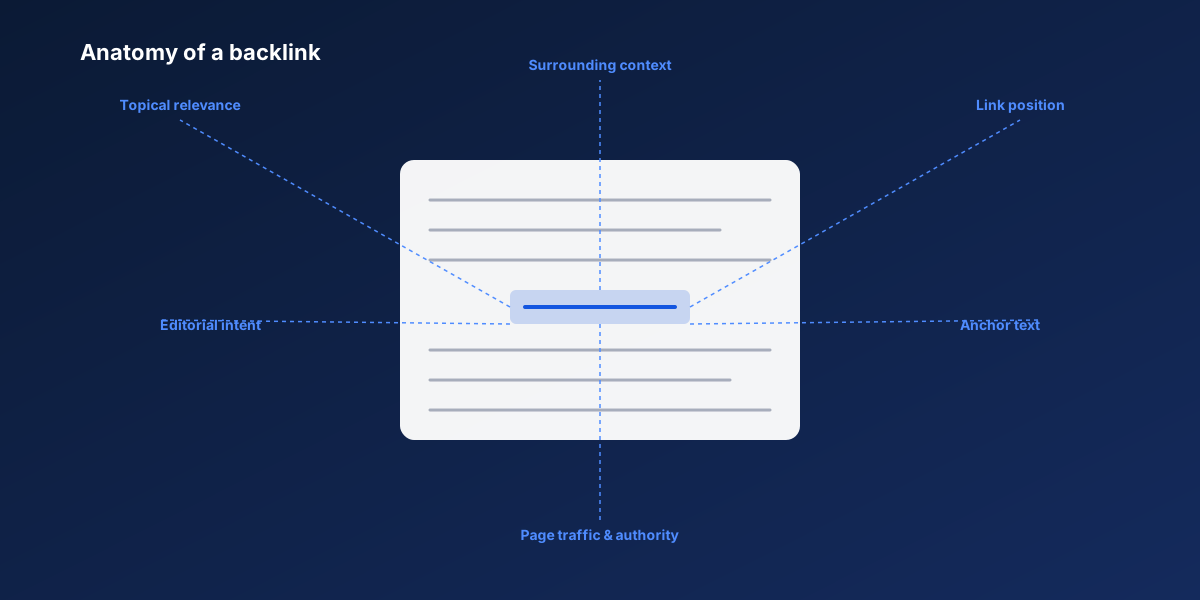
DR 80 is not a quality marker. DA 60 is not a quality marker. “Has a Wikipedia link” is not, by itself, a quality marker. The third-party authority metrics that every link-building vendor leads with were useful in 2014, are mildly useful in 2026, and are routinely gamed by the kinds of sites you do not want to be associated with. A serious link-building program evaluates placement opportunities across multiple dimensions, with the third-party metric as one input among many — and usually not the most important one.
This is the framework we use internally at Linkiva when we evaluate prospects for our link-building clients. Seven dimensions, each scored independently, with a heuristic for when a single weak dimension is acceptable and when it is disqualifying.
1. Host page traffic — the load-bearing signal
The single most reliable indicator that a host page is genuinely high-authority is that it has organic traffic. Not the publication’s homepage; the specific URL where your link would live. A page with measurable monthly organic visits is a page that Google considers authoritative on its topic, that ranks for queries with real volume, and whose link will be crawled, re-crawled, and contextually weighted in your favour.
A page with zero organic traffic is, almost always, either too new for Google to have evaluated yet, too thin to rank for anything, or actively penalised. Any of those is a problem. There are exceptions — a fresh news article on a major publication can have zero traffic on day one and substantial traffic on day seven — but as a default heuristic, evaluating prospect-page traffic eliminates a substantial percentage of the link-vendor inventory that gets quoted as “high DR”.
The tools that report this reasonably well — Ahrefs, Semrush, similar — show estimated organic traffic to the specific URL. A page with 50+ monthly visits is meaningfully more valuable than a page with zero, and a page with 500+ is meaningfully more valuable than 50. The numbers are estimates, not gospel, but the order-of-magnitude differences are real.
2. Topical relevance
Topical relevance is the second-most-important signal and the one most often given lip service rather than real attention. A link from a real publication is worth far more when the publication, the host page, and the surrounding paragraph are all topically aligned with your business.
There are three layers to evaluate. Publication-level: is the publication’s overall topical focus relevant to your industry? A link from a general tech publication is fine; a link from a publication focused on your specific category is materially better. Page-level: is the specific article topically aligned, even if the publication is general? A general tech publication’s article about your category-specific topic is excellent. Paragraph-level: is the paragraph around the link topically aligned? A link in a paragraph discussing your category specifically is doing more work than a link in a paragraph that mentions you in passing among unrelated brands.
Where topical relevance falls apart is “looks editorial but is actually a content marketplace.” Many of the publications that score well on classical authority metrics are now functionally link marketplaces — they accept guest posts on any topic that pays. The topical relevance of any single link on these publications is whatever the article’s writer chose to make it, often with no genuine alignment to the publication’s core readership. These links increasingly get devalued algorithmically; treat them with caution.
3. Link position on the page
Where the link sits on the page matters. The hierarchy, in approximate order of value:
- Main body, top third of the article: the strongest position. The link is in editorial content, near the part of the page with the most reader attention.
- Main body, middle and bottom: still strong, particularly if the surrounding context is on-topic.
- Resources section at the end of an article: weaker than in-body, but still editorial. Value depends heavily on the quality of the surrounding resources.
- Sidebar: typically weaker than body links, particularly when the sidebar is the same across many pages (it then looks like a sitewide template element).
- Footer: generally devalued, particularly for sitewide footer links.
- Author bio: variable. Bios on real authors with real publication histories carry some value; bios that exist only to host paid links are devalued.
A high-value link in a body paragraph is worth more than a high-value link in a footer, and worth substantially more than a sidewide footer link that appears on every page of the site.
4. Surrounding content
The content immediately around the link signals to Google what the link is “about” in a way that anchor text alone does not capture. A link sitting in a paragraph discussing your specific niche, with the link contextually supporting the surrounding argument, transmits topical signal in addition to PageRank flow.
A link sitting in a sentence that makes no sense, surrounded by paragraphs about unrelated topics, transmits the signal “this link is here to exist, not because it belongs in the content.” Google’s content quality models increasingly read paragraph-level context, and link signals that contradict the surrounding content are increasingly discounted.
In practical evaluation: read the paragraph around the link and ask whether the link would still belong if it were the only link in the article. If the answer is no — if the paragraph reads as constructed to host this link rather than naturally containing it — the link is in a weaker position than the host-page metrics suggest.
5. Anchor text and anchor distribution
Anchor text is a direct ranking input, but anchor strategy is a programme-level discipline rather than a single-link decision. The mistake most agencies make is over-optimising single placements — using exact-match commercial anchors on every link they place — without thinking about the resulting anchor profile.
A defensible anchor profile across a campaign mixes:
- Branded anchors (the brand name)
- Naked URL anchors (the URL as the visible text)
- Generic anchors (“click here”, “read more”)
- Partial-match anchors (some keyword variation around the brand)
- Topical anchors (the topic the page covers, no commercial keyword)
- Exact-match commercial anchors (the head term the page targets)
The ratios shift by industry and by stage of the campaign. As a rough starting point: 30–40% branded, 10–15% naked URL, 10–15% generic, 20–25% partial-match and topical combined, 10–15% exact-match commercial. Exact-match commercial anchors are the powerful ones; they are also the most detectable when over-used. Use them on a minority of placements, weighted toward the highest-authority hosts.
6. Link velocity and pattern
How quickly links arrive and how they are distributed over time is a less-discussed dimension that matters. A page that goes from zero backlinks to fifty backlinks in one month, all from publications with similar editorial patterns, all with the same anchor variations, is a pattern that contemporary link analysis flags reliably.
A campaign that produces five to fifteen placements per month over many months, from a diverse set of publications, with a balanced anchor mix, looks indistinguishable from a brand that is earning organic editorial coverage at the rate strong brands actually do. Slower link velocity, more diverse sources, and longer time horizons are the safer profile.
7. The host site’s own backlink quality
The site whose page is hosting your link has its own backlink profile, and the quality of that profile is a layer of authority that flows through to your link. A publication whose own backlinks come predominantly from real news publications, government domains, universities, and major industry publications is passing a different quality of equity than a publication whose own backlinks come from a long tail of low-quality directories.
This is harder to evaluate quickly than the per-page traffic check, but it is one of the strongest predictors of whether a high-DR publication is actually high-authority or whether its DR is gamed. A two-minute look at the publication’s own backlink profile (in Ahrefs, Semrush, or similar) will tell you whether you are looking at a real publication or a sophisticated content marketplace dressed up as one.
Putting it together
No single dimension is sufficient. A page with 5,000 monthly visits and zero topical relevance is less valuable than a page with 500 visits and tight topical alignment. A perfectly contextual link in a footer is less valuable than the same link in the body. The framework is a multi-axis evaluation; the goal is to identify placements where multiple dimensions are simultaneously strong.
The shorthand we use internally: a “tier one” placement scores well on at least five of the seven dimensions, with no dimension catastrophically weak. A “tier two” placement scores well on three or four, with the rest acceptable. Anything below that — placements that score on host-page metrics but fail on three or more of the other dimensions — we typically pass on, even if the price is right and the publication looks impressive.
What this means for your link strategy
If you are evaluating link-building proposals, the questions worth asking are not “what DR can you get me at what price.” They are: what is the typical host-page traffic on your placements, how do you evaluate topical relevance, what does your anchor distribution look like across a typical campaign, what’s the velocity profile, and can I see ten placements you ran for similar clients?
The vendors that have good answers to all of these are doing serious work. The vendors who change the subject are selling DR.
If you would like a backlink audit run against this framework — a structured look at your current profile and a prioritised plan for the next twelve months — that is the front end of our link-building engagement. The output is the same framework applied to your situation, with explicit recommendations on what to keep, what to build on, and what to discount.